How DisputeDash handles a dispute from the moment it opens: the evidence it builds for each reason code, the controls you keep over every brand, and the record of everything it does in your name.

From the moment a dispute lands to the moment the response is submitted, nobody has to watch the clock. Prefer a human check? Put any brand on review and approve each packet in one click.
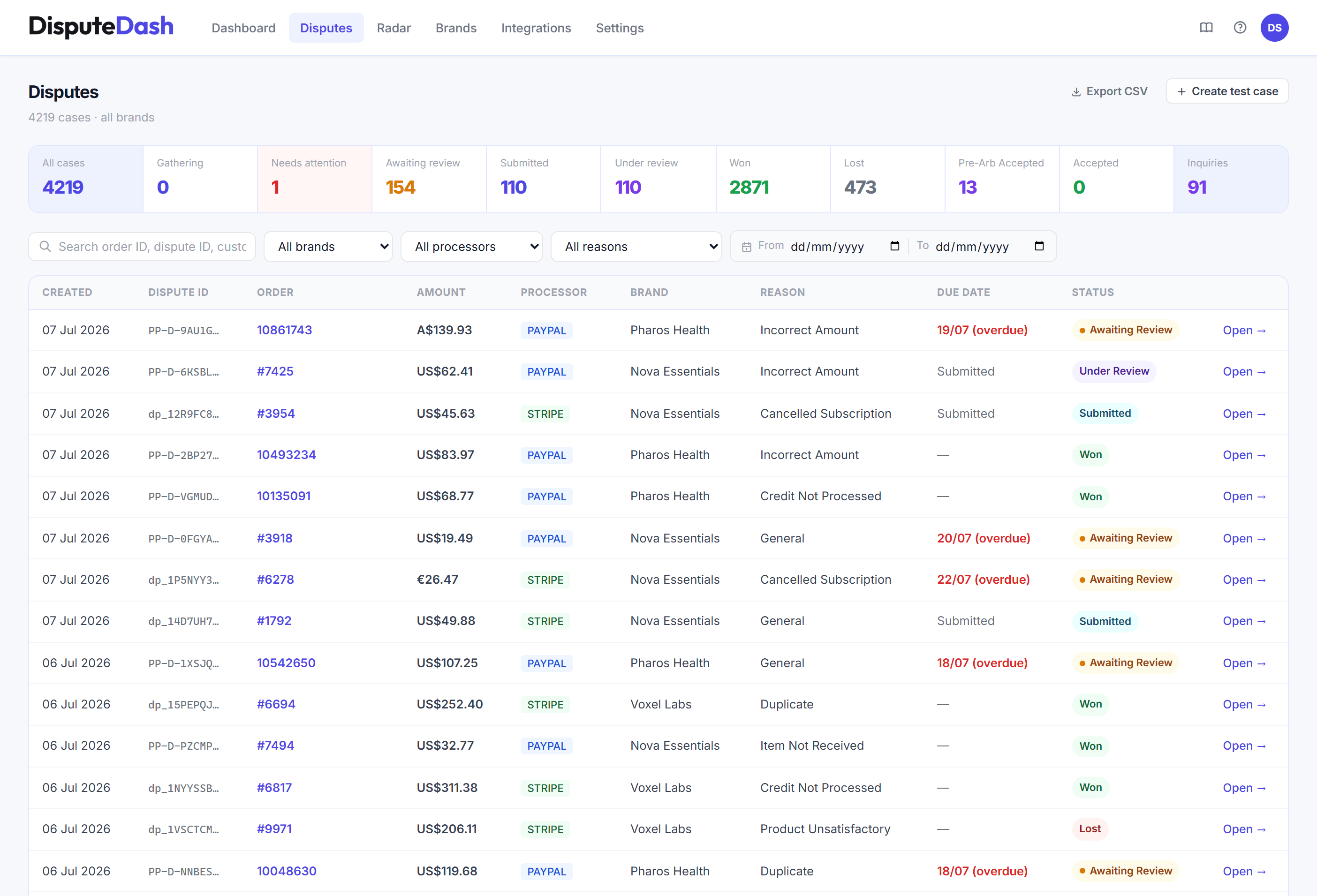
Your processor notifies DisputeDash the moment a dispute opens, and it is ingested in real time. No manual entry, no daily exports, no inbox-watching.
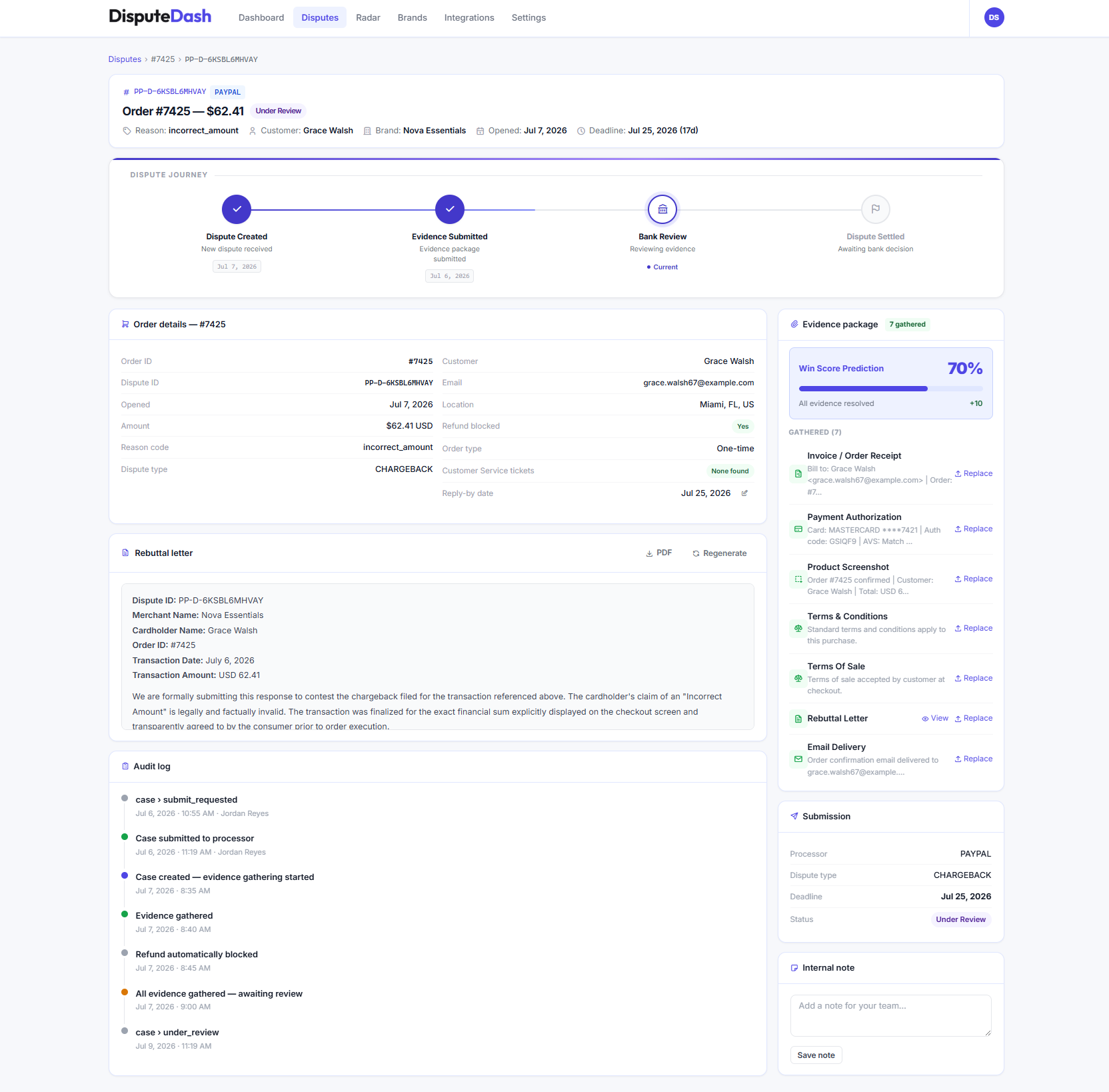
Evidence is pulled from your checkout platform, fulfillment app, carriers and support desk, then assembled into a package for the dispute's reason code.
The package goes to your processor minutes after the dispute arrived, not the night before it's due. Auto-submit, or hold it for one-click approval, per brand.

Every case tracks its own journey: created, evidence submitted, in review, won.
Many tools send the bank whatever they can scrape. DisputeDash reads each dispute's reason code and builds a structured package for that case from a library of 15 evidence types, most gathered automatically from your integrations. Your evidence settings and rebuttal letters are yours to control, so you always know what's submitted in your name.

Where AI fits in, and where it doesn't. Evidence building is deterministic: your real order, delivery and payment records, assembled to the reason code's requirements, never generated content. AI is used for analysis in Radar, which reads your dispute stream and points out what's driving losses. It never writes what's submitted in your name.
What evaluators check before they hand disputes to software: who decides, what gets sent, and whether there's a record.
Auto-submit straight away or after a 2, 4 or 24 hour window to step in, or hold every packet for a person to approve. Set a workspace default and override it for any brand.
Choose the evidence gathered for each reason category, and mark the primary proof: a case missing all of it is held for review instead of auto-submitted. Decide whether pre-arbitration is accepted, fought, or fought above an amount you set, and whether to fight disputes on refunded orders.
View, upload or replace any evidence file on a case before it goes out. Rebuttal letters come from templates you can edit, override per brand and regenerate on an open case.
Add documents your integrations can't reach, such as a signed delivery note or a call log. Upload your terms, refund policy and terms of sale once per brand, and they're attached as evidence automatically.
Every action, by the system or a person, timestamped and searchable on the case. Nothing is submitted or resolved in your name without a visible trail.
Each brand has its own processor accounts, templates, assets and settings. Outcomes roll up by brand, processor, reason code and result, and you never pay per brand, processor or seat.
Visa's CE3.0 rule lets you beat "I didn't authorize this" (reason 10.4) chargebacks when the same cardholder has a track record of undisputed orders. DisputeDash applies it automatically on every qualifying Visa fraud case, including subscription rebills that carry no IP of their own.
Every Visa 10.4 fraud case is screened for CE3.0 the moment it arrives. No tagging or triage.
Prior orders are matched against the four data elements: IP, device, account and shipping address.
Rebills inherit the original signup's IP and footprint, so recurring charges qualify where raw rebills can't.
A prior-transaction-history document is generated and added to the evidence packet automatically.
Applied at representment, CE3.0 gives the issuer a documented reason to rule in your favor, a materially stronger case on top of the rest of your evidence. On by default for Visa fraud disputes.
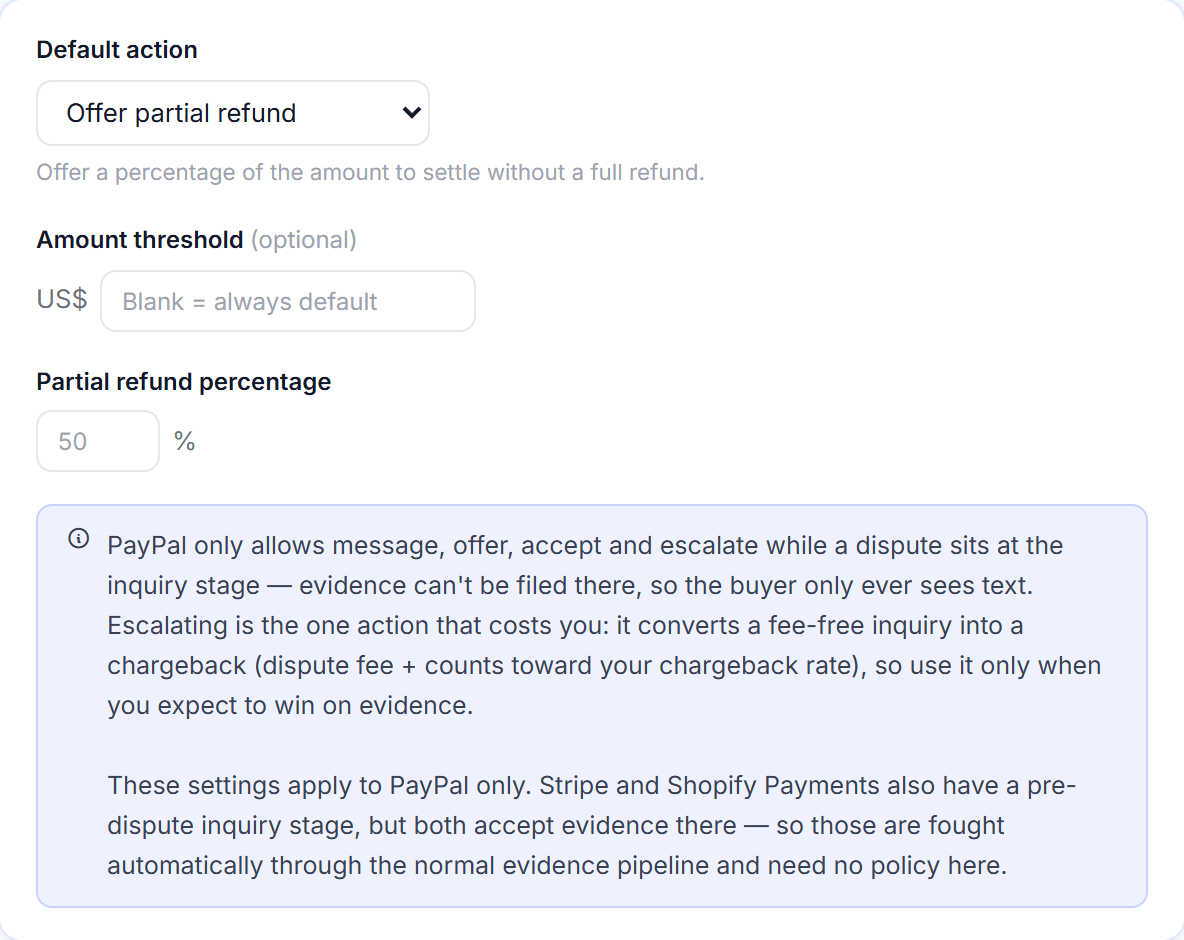
How CE3.0 worksPayPal opens many cases as an inquiry: a question, not yet a chargeback. Resolved at that stage, it never becomes one. DisputeDash makes that call on order data (fulfillment state, delivery proof, refund history), not on the dollar amount alone, so it decides from what actually happened.

Radar reads your dispute stream and ranks what's driving losses, each finding with a recommended action. Growth plan and above.
AES-256 encryption, least-privilege access and a full audit trail on every action. Nothing is submitted in your name that you can't see first.
Connect a processor and see your disputes, win rate and what they cost you in DisputeDash, free. No card.